

Starting an ed policy Substack with a likely controversial take is probably not best practice. But here we go.
Tomorrow, the Texas Education Agency releases this year’s accountability ratings. Austin ISD has been the focal point of state and local media, as three of its middle schools, Burnet, Dobie, and Webb, each carry four consecutive failing ratings. A fifth failing grade at any one of them triggers a state law requiring Commissioner Mike Morath to either order the campus closed or replace Austin’s elected school board with appointed managers.
Austin spent the last year trying to avoid that outcome. It voted to close ten campuses in November 2025. It asked the state to let a nonprofit operator run the three middle schools, and the state turned the application down in May. It closed a fourth middle school weeks before this school year began.
The argument in Austin has taken the shape these arguments always take, local democracy on one side and state authority on the other. That argument matters, but it stops short. A district is not just a school board. It is the adults a child sees every day, and everyone in this fight, on both sides of it, wants an effective teacher standing in front of every child in August.
If a state-appointed board takes control of Austin ISD, there will be the usual coverage of the adults this affects. Parents will talk about leaving the district. School leadership will change. Some families, teachers, and community groups will oppose the new board before it has done anything at all.
Teachers will leave too, as we have seen before. Fort Worth ISD has had over a thousand teachers resign or retire since its state-appointed leadership arrived in March 2026, the district’s largest exodus in nine years. Beaumont ISD eliminated 300 teaching positions and additional teachers left following state intervention in 2014. This is a cause for concern, because teachers are the most important in-school factor in how much students learn.
Still, not all turnover is bad turnover. Whether a district is better or worse off depends on who left, who replaced them, and whether students end up having more effective teachers. Houston ISD's takeover is perhaps the most contentious to date, and it is one case worth a closer look to learn what may result from future takeovers
Two stories out of Houston
Houston ISD serves roughly 175,000 students across 250-plus campuses, making it the largest district to experience a state takeover in American history. Houston ISD’s turnover jumped to 32 percent in 2024-25, about 1.7 times the statewide rate. Even after the post-pandemic surge of teachers leaving the classroom, that is a shocking number. A district that loses a third of its teachers is one with a concerning potential for long-term instability.
But the results from the takeover point to real improvement for students. In last year’s ratings, no Houston ISD campus received an F for the first time since Texas began issuing letter grades, down from 56 two years earlier, and the state extended the intervention through 2027 while citing the improvement. Skeptics should rightfully note that these ratings reflect TEA’s grading of its own intervention, which is fair. That is why this post will focus on the teacher workforce that underpins the ratings.
Two things are worth reconciling with a fuller picture of the data. A district that loses a struggling teacher and a district that loses an excellent one both have turnover. But for the children in those two classrooms, it does not produce the same result. The question worth asking about Houston ISD is not how many teachers left. It is which ones.
What the data show
Using statewide data, I followed every Houston ISD teacher over a decade and compared Houston ISD’s teacher workforce before and after the takeover with similar districts that were not taken over. I determined a teacher’s effectiveness by how much their students gained on state tests over a year, relative to what similar students gained elsewhere in Texas. For my data nerds, see my note on how I measured effectiveness at the end of the article.
There are three findings that help make sense of why students in Houston ISD performed better academically post-takeover.
The first is about which teachers left. In 2024, 33.4 percent of Houston’s least effective teachers left the district compared to 23.9 percent of its most effective. In the figure below, the red line tracks turnover among the district’s least effective teachers and the gold line tracks its most effective. Before the pandemic, Houston reliably lost its weakest teachers faster than its strongest. Hurricane Harvey in 2017-18 and the pandemic in 2020 erased that gap. From 2020 through 2022 the two groups left at nearly the same rate, meaning the district was losing its best teachers just as fast as its weakest.
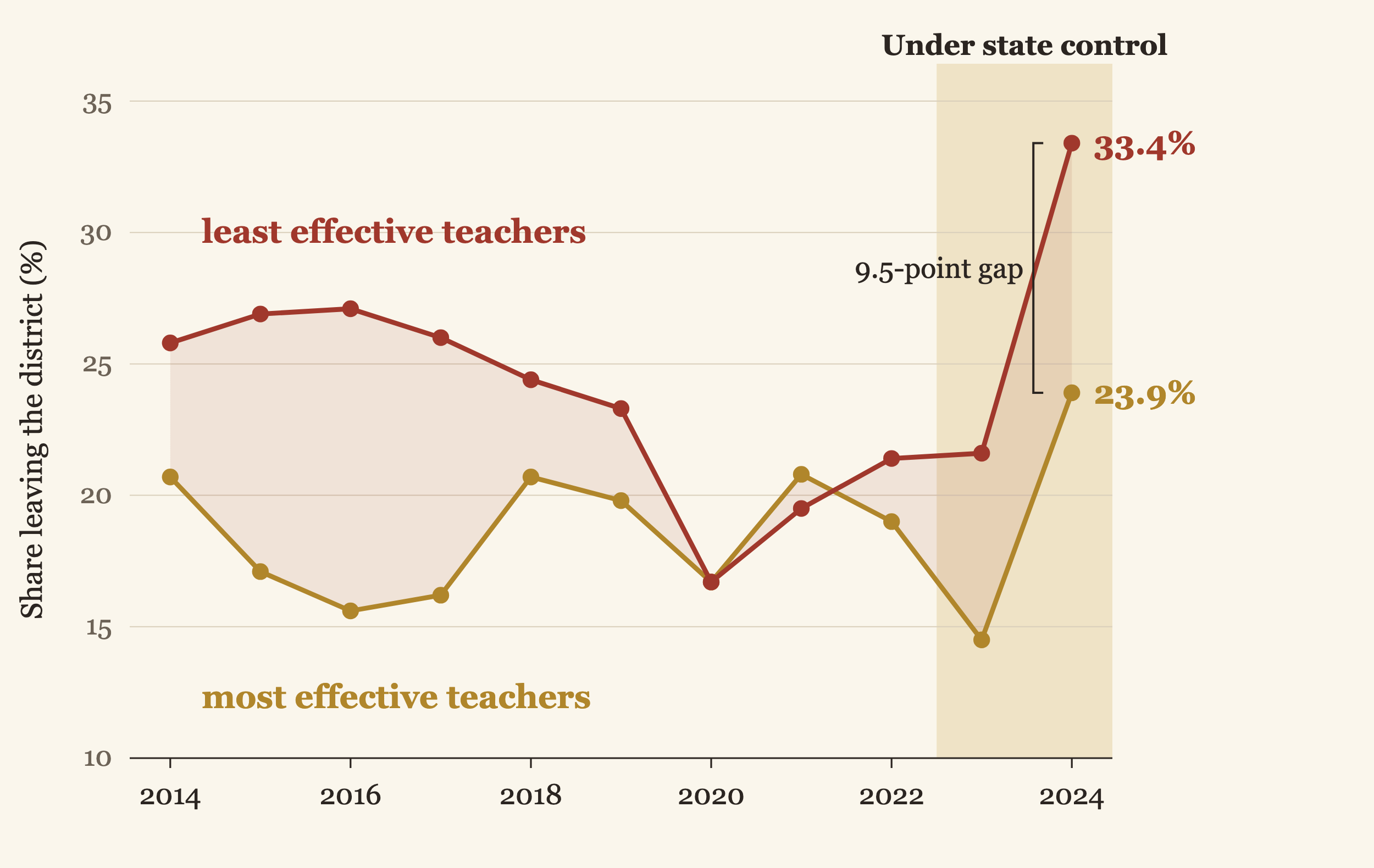
The two years under state control brought the gap back to an extent not seen since 2016. And in 2023, the most effective teachers left at the lowest rate in the data. In 2024, the gap between the two groups reached 9.5 points, even as turnover increased across the board. What Houston ISD has now is a workforce where the most effective teachers are staying in the classroom, and the least effective teachers are leaving. That is a good thing for kids.
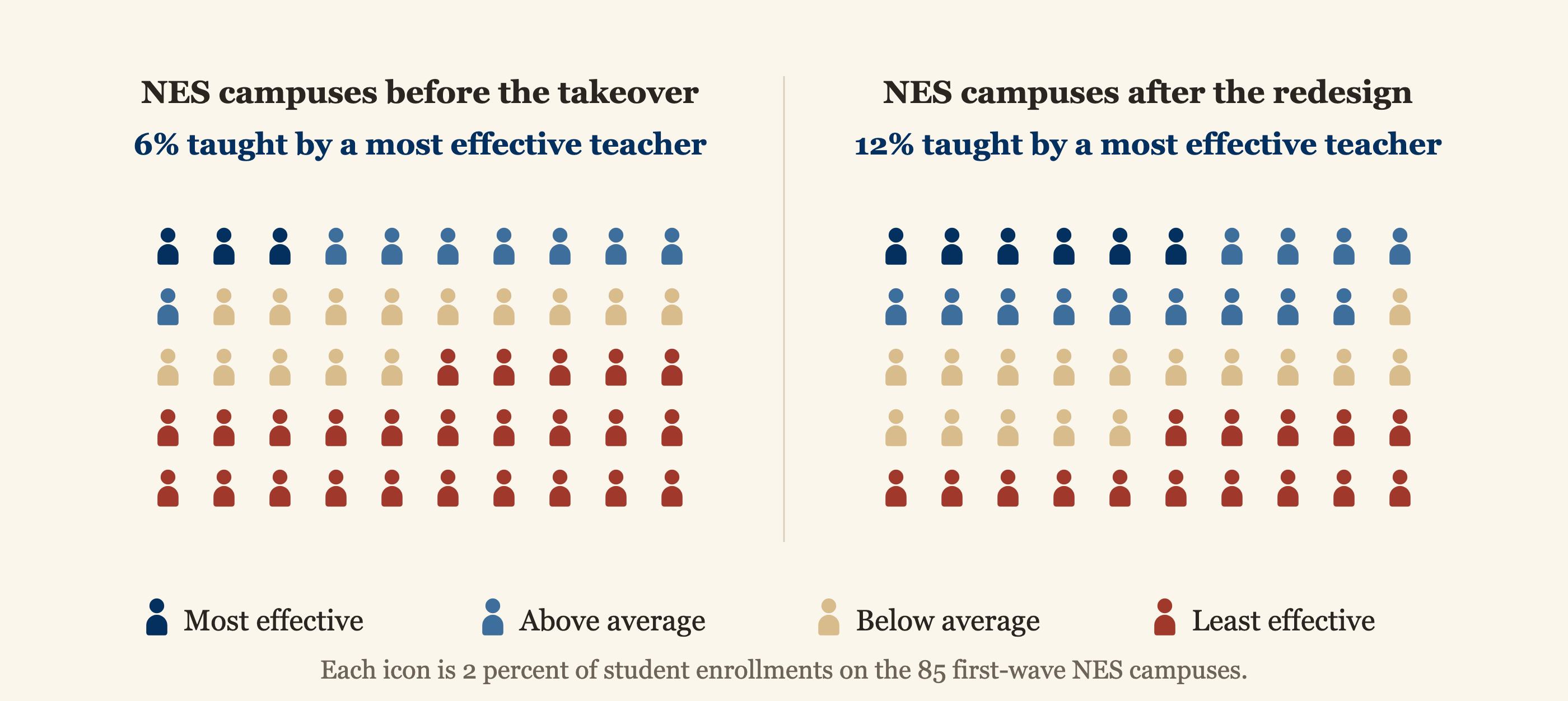
The second finding is about where the strong teachers who stayed taught the next two years. The 85 campuses Houston ISD put into the first wave of its New Education System (NES) serve some of the poorest children in Texas. NES redesigned staffing and instruction at those campuses by making every employee reapply for their job, paying rehired teachers substantially more, and shifting non-instructional work like grading to aides so teachers focus on instruction. For years, those campuses disproportionately employed the least effective teachers in the district. By 2024, those campuses had a much larger percentage of the best teachers in the district. The share of students on those campuses taught by one of the district’s most effective teachers had roughly doubled.
The third finding concerns which teachers replaced those who left. New teachers hired in 2024 were about as effective as the average Texas teacher, a significant jump in effectiveness compared to prior new teacher cohorts in the district. While I cannot observe specific supports teachers receive in the data, this suggests the district is likely providing better induction support and/or hiring better teachers to start with.
Remaining risks of takeovers for the teacher workforce
These data do not support the idea that significant disruption to a school district results in only positive outcomes. A district that loses thousands of teachers at once fills the gaps with whoever is available in July, which comes with a real risk. My own work on uncertified teachers in Texas finds their students lose months of learning and these teachers do not stay in the classroom. The newest data from Houston ISD show the first sign of that cost. Houston’s 2024 brand-new hires were as effective as the average teacher in Texas. But the 2025 hires, half of whom were uncertified, were below the state average, and we will not know the implications of these hires on student achievement for another year or two. Turnover cuts both ways, and who replaces the teachers who leave will drive the outcomes for kids.
Whatever the case may be, we must treat stability as part of the work rather than something that sorts itself out years down the road. Future state takeovers should consider questions that have answers supported by the data. Who mentors the teachers who stay? What does a first-year teacher get in their first ninety days besides a standardized curriculum? How does a campus rebuild what it had with families who left alongside the staff? None of that shows up in an accountability rating, which is why it tends to get improvised. Districts can plan for this instead.
In fact, the simple question of how we expand the reach and impact of effective teachers is one all districts can seek to answer now. It should not take the threat of state intervention to develop strategies to ensure we are maximizing students’ chance of having a teacher who is ready for the job, especially students who are not adequately being served today.
What this means for Austin and future takeovers
I am not arguing either for or against district takeovers. My argument is that a takeover should be judged by whether the children who waited longest ended up with better teachers. If the state intervenes in Austin ISD, there will be headlines about hundreds of teachers leaving, but that number alone will not tell anyone what the takeover means for kids. Without proper scrutiny, the turnover rate will overshadow which teachers left, who replaced them, and whether the students who have been waiting the longest ended up with better teachers, as appears to have been the case for Houston ISD thus far.
The other honest thing to say is that what sits underneath those headlines is already serious. No one can dispute that students at these campuses have been underserved for years. The law that forces the commissioner’s hand exists because Texas decided no child should spend years of their schooling in a place we already know is not serving them. People can disagree in good faith about whether a board of managers is the right remedy, and many thoughtful people in Austin do. It is harder to argue that a campus with a fifth failing year is acceptable.
So the thing worth asking for, in public and before anything is settled in the spring, is not a promise that turnover will stay low. It will not. It is a plan for the adults who stay: how the district intends to support the effective teachers already in those buildings, how it keeps them in the classrooms where they are needed most, and how it gives everyone who cares about Austin ISD and its students a reason to keep showing up.
And the most useful thing in the Houston data has almost nothing to do with takeovers. The largest single change was not who left. It was which children ended up with the district’s best teachers. No state law is required to do that. It is the one thing in this story that any district in Texas, under intervention or not, could take up this year.
A note on measurement. When I describe a teacher as among the most or least effective, I mean how much their students gained on state tests over a year compared with what similar students gained elsewhere in Texas, averaged across their career and adjusted for the imprecision of any single year of scores. The district comparison uses a staggered difference-in-differences estimator (Callaway and Sant’Anna, 2021), which compares Houston’s before-and-after change with the change in districts that were not taken over. Full detail is in the policy brief (link to come).
Thank you for this, Jacob! An interesting read and fair take on a divisive topic.
I really appreciate the depth and nuance here! This is what is often missing from public discourse on education (and, you know, every other policy issue in the universe).
I'll be curious to see what the trend line for turnover of highly effective teachers looks like in HISD over the next few years ... Good to see it's now lower than turnover for less effective teachers, but yikes, still feels like too much!
I am also haunted by your point that dropping less effective teachers is only helpful if better ones are available to step in ... 😬