

Why I’m writing Article VII
In ninth grade, I was reading at a third-grade level. I grew up in Lubbock, Texas, and I’m lucky that my career eventually brought me back to work in my hometown. Statistically, nothing about my trajectory pointed to going to college, much less a career spent studying schools. But a teacher decided I was worth the trouble. Knowing my competitive spirit, they told me to join speech and debate to help with my reading and writing, referred me to an intensive and free SAT test prep workshop, and built the kind of positive teacher-student relationship that research consistently identifies as one of the strongest levers schools have. I won’t overdramatize my experience. It was one adult, paying attention, changing what I believed I could do. I work with statistics for a living now, so I know better than most just how close I came to a very different life.
When I got to college, I chose to major in economics (because obviously I wanted to go to law school, run for president…you know the type…). I took one education course and, motivated by my own experience, changed career paths to pursue my teaching certification. I loved teaching. I loved the idea of being that teacher who helped me. That changed after just one conversation. One class away from finishing my certification, I asked my university supervisor back in 2014, “Is there any way I could eventually make close to $80,000 as a teacher?” The answer was no.
As is rational when considering any career, my biggest priority was having a career that afforded financial stability. I grew up broke and could only afford college through financial aid, at an expensive school where most students paid full tuition and skied on the weekends. Needless to say, I have always been blunt about money. And despite changing paths, I have always believed you can take every professional experience you’ve had and use that story as a springboard into what’s next.
I went to grad school with a keen interest in figuring out how to actually change the teaching profession, so that someone like me, an optimist who still believes education can be a common denominator for students, would go into teaching as a true career, not a stopgap. Today, I’m so fortunate to be a professor. I get to dedicate my days to studying the systems I navigated with some luck and stubborn refusal to let where I started decide where I ended up.
Study after study, I find myself asking: What do our education systems actually reward, and are those rewards working for students?
That question is bigger than the teaching profession, though teachers are where it shows up first. I think about the high school junior left with little guidance from family trying to decide whether to take a dual credit course. I think about the district choosing what resources to reallocate or what systems to overhaul to ensure schools are staffed with high-quality educators. I think about a high school graduate who doesn’t go to college deciding whether to spend the time and money to pursue a workforce credential. Every one of those choices is somebody quietly doing the math, the sum of which amounts to whether a kid in Texas ends up with a real shot at economic opportunity. That is what I study, and this newsletter is a place for me to write down my hot takes, supported by data.
Why “Article VII”
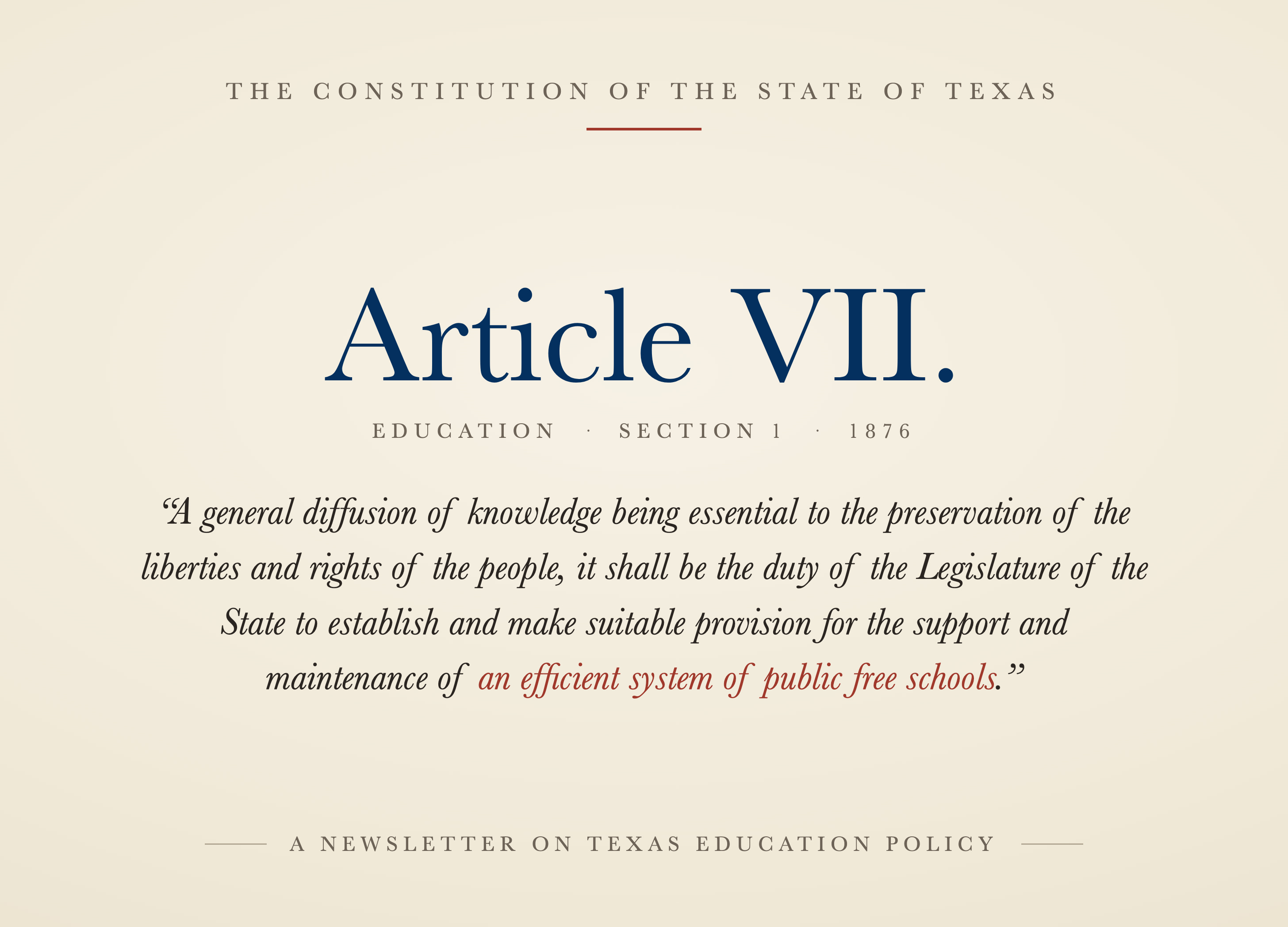
Established in 1876, Article VII of the Texas Constitution says the general diffusion of knowledge is essential to preserving Texans’ liberties and rights, and it tasks the Legislature to provide “an efficient system of public free schools.” The same article goes on to establish the funds that built our state’s universities. The article tasks the state with supporting Texans from the pre-kindergarten classroom through college with an implicit goal of every Texan to earn a living and take part in public life.
So the name is a standard more than a brand, for me and the state. Every legislative session, agency rulemaking, and district hiring decision is, one way or another, an attempt at keeping that 150-year-old commitment. That commitment is personal for me. I have seen up close what access to a high-quality education can do.
Why now
Texas is not a sleepy place to study education policy. Our state runs the largest teacher merit pay system in the country, implemented the largest school district takeover in American history, spent a decade running the nation’s biggest experiment in deregulated teacher hiring, and then, last year, reversed it. From decades of policymaking, we see that when Texas gets something right, other states copy it. When Texas gets something wrong, we put a lot of kids at risk.
Much of this work gets done in the background, but quite a bit also gets covered by a lot of noise. Headlines, press releases, advocacy one direction and outrage the other. I’ve always been interested in how each is armed with a statistic or two that sounds decisive but usually has a lot more nuance. Much of my research uses the state’s massive longitudinal data system, which maintains information on students, teachers, and schools for decades. It allows you to connect students from their time in early childhood to college and/or the workforce. We can follow what happens after little and big policies and decisions are made. My policy briefs are where I summarize what I learn. This newsletter is where I tell you what I think it all means.
What to expect
I will write roughly twice a month, or whenever I feel like saying something. Most posts will run about a thousand words, unless the issue warrants more. I can offer you a few promises if you decide to read. I will do my best to not hit you over the head with a bunch of data. I’ll cut through the technical jargon and tell you what the statistics mean. And (sorry nerds), I will never present a regression table with stars and p-values, but usually there will be a note at the end and/or a policy brief with that information. When I am giving you my opinion, I will label it as mine. If a finding cuts against something I have argued before, it goes in the piece anyway.
The first three essays are already on the way. The first takes a look at state takeovers with a focus on Houston ISD, and what districts can learn from it. The second asks why Texas’s teacher merit system is delivering results and what makes it different. And the third is an open letter to my own corner of the world, Colleges of Education, about the second chance the Legislature just handed us and what it will take not to waste it.
Texas first, always, but I hope the lessons will travel. If you are a parent, a teacher, a principal, a legislative staffer with five minutes, or a researcher who wants to see the Texas data put to honest use, this is meant for you.
The ask
Article VII is free. Subscribing just means my thoughts land in your inbox, and it tells me somebody is reading.
If you know one person who cares about Texas schools, a colleague, a board member, the friend who always asks you what’s really going on with the teacher shortage, forward this to them. That is how a newsletter like this finds its readers.
Somewhere in Texas today, there is a ninth grader reading years behind grade level, and a young adult doing the math on whether a life in the education profession adds up. The Texas Constitution promises one of them an efficient system of public free schools. It cannot keep that promise without the other. I write this newsletter to keep track of our commitments to Texans. Thanks for reading.
Thanks for sharing about yourself Jacob. Your research is making a difference in the ways you want. Substack is a great way to lay out thoughts with more expanse than LinkedIn but less demanding than the peer-review gauntlet.
Thank you, Jacob, for this. I'm looking forward to reading your thoughts. Though, I do appreciate a good regression table. HA!