

There’s one question that motivates all of my research on the teaching profession. How do we shake up this system so that motivated people will choose teaching as a career? I think the answer starts with economics.
It’s not like the average starting salary for teachers is bad. In 2024-25, the average first-year Texas teacher made about $55,700. The typical 2023 graduate of a Texas public university made about $51,200 the next year.
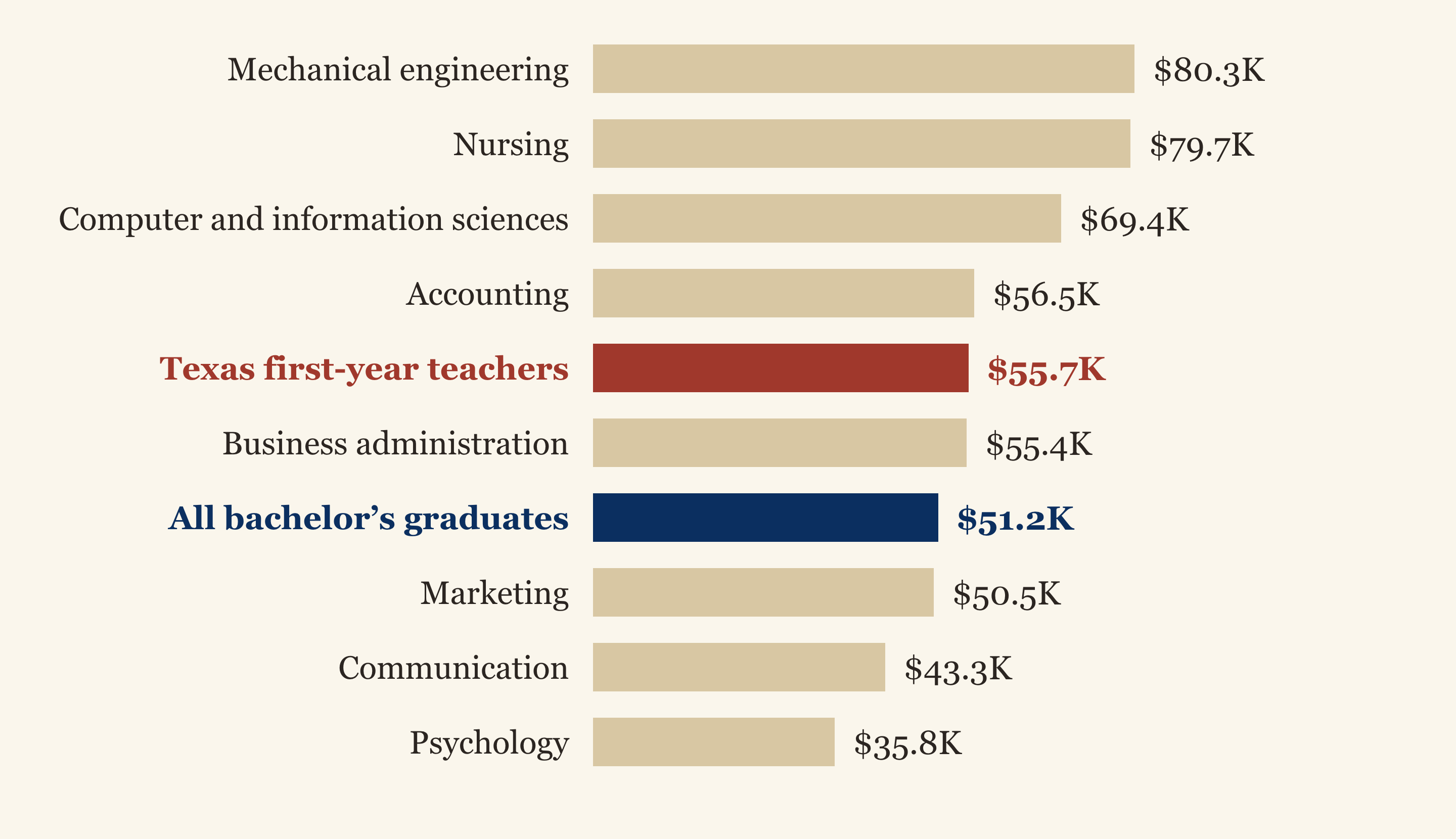
Median 2024 wages of 2023 bachelor’s graduates of Texas public universities, by major, and the average first-year Texas teacher salary, 2024-25. Sources: Texas CREWS; Texas Education Agency.
But getting there cost a very different amount of time and money depending on the route. The university path usually means a semester or a full year of unpaid student teaching. A fully online certification program costs about $6,000, and you’re teaching on a full-time salary while you finish certification. And as we’ve seen in the headlines, you could also just start teaching with no certification at all.
Until this year, all three got you to roughly the same starting salary. The person who gave up a semester or year of income for clinical training earns the same as the person who was teaching and earning a salary that entire time. If you compared the paycheck to the uncertified teacher’s down the hall, you could say there was not a return on investment.
We never ask humans to act against their economic well-being. Why do we assume we can ask that of future teachers? Unfortunately, we have done that for a long time. But now, future teachers have started to act in their rational economic best interest. In 2016-17, the affordable, fast-track online teacher preparation programs surpassed universities in the share of new teacher hires. Through the 2015 District of Innovation law, most districts began waiving teacher certification requirements altogether following the pandemic. A decade later, this is what we have become used to as the three most common pathways into the teaching profession.
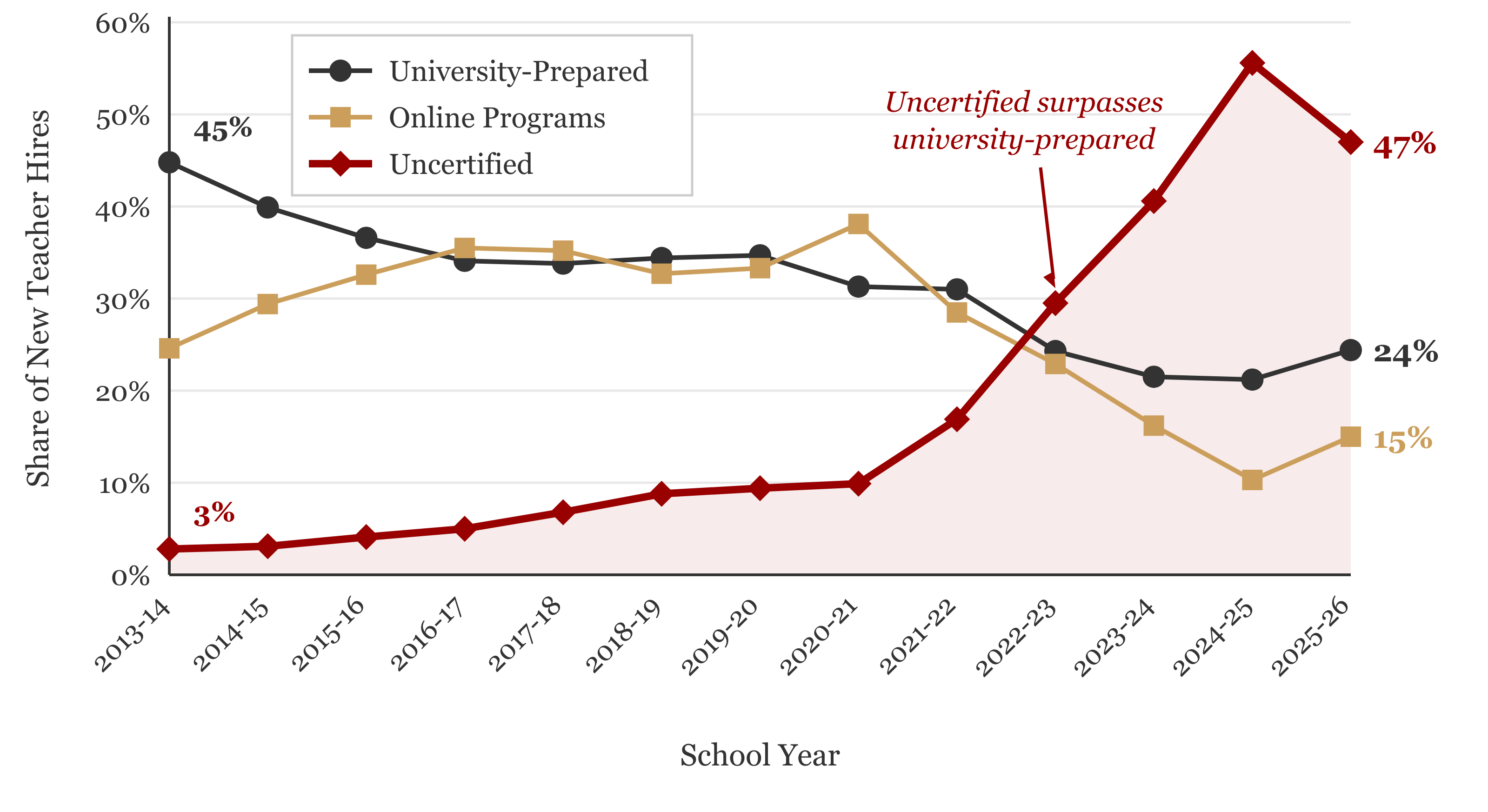
Share of new Texas teacher hires by route, 2013-14 to 2025-26. Source: Author’s analysis of Texas Education Agency data.
What Texas got right
With Texas House Bill 2, the state recognized that preparation, compensation and retention are all part of the same equation.
On the preparation side, the new PREP allotment pays districts to host teacher residents, who have to be paid at least $20,000 for the year, and pays their preparation program once they’re certified and have taught a year in the district. We are paying people to choose high-quality preparation, so that the fast track isn’t the only economically viable option that people have.
On the compensation side, districts now have to start first-year teachers who hold a standard certificate, or the enhanced certificate residents earn, at a higher salary than first-year teachers without one. The law says districts must pay teachers $3,000 more if they have a standard certificate and $6,000 more if they have an Enhanced Standard Teaching Certificate. And the Teacher Incentive Allotment (TIA), which pays teachers for being effective, was expanded so that a teacher can make as much as $36,000 in additional compensation annually, guaranteed for a minimum of five years. So we’re moving from a place of just average raises based on years of experience to rewarding preparation and effectiveness.
Does preparation pay off?
In a statewide study covering 2014 to 2023, I found that students of teachers from fully online programs did worse in reading and math than students of new teachers from traditional university programs, and teachers from the online programs were more likely to leave the profession. In my most recent study of uncertified teachers, a single year with an uncertified teacher, rather than a new teacher from a traditional university program, cost students between one and four months of learning.
On the other end of the spectrum, a teacher residency stretches student teaching into a full school year, with the future teacher working alongside an experienced mentor teacher. At Texas Tech, Tech Teach is the residency for traditional undergraduates, and Tech Teach Across Texas (TTAT) extends that model statewide, with coursework online and the residency in a district in the candidate’s own region. The University of Texas El Paso (UTEP) puts every candidate through its Miner Teacher Residency.
For all three, I compared residency graduates with new teachers from traditional university programs at the same campuses. Students of Tech Teach and TTAT teachers gained roughly 0.7 and 1.3 additional months of learning, and students of UTEP’s residents finished the year about four and a half months ahead in math and five and a half months ahead in reading.
I should be clear: Not all alternative certification programs are bad, and I do not believe that universities should be the only organizations that prepare people to become teachers. There are a lot of great programs outside colleges of education. That’s the beauty of having the diverse teacher preparation landscape that we do in Texas.
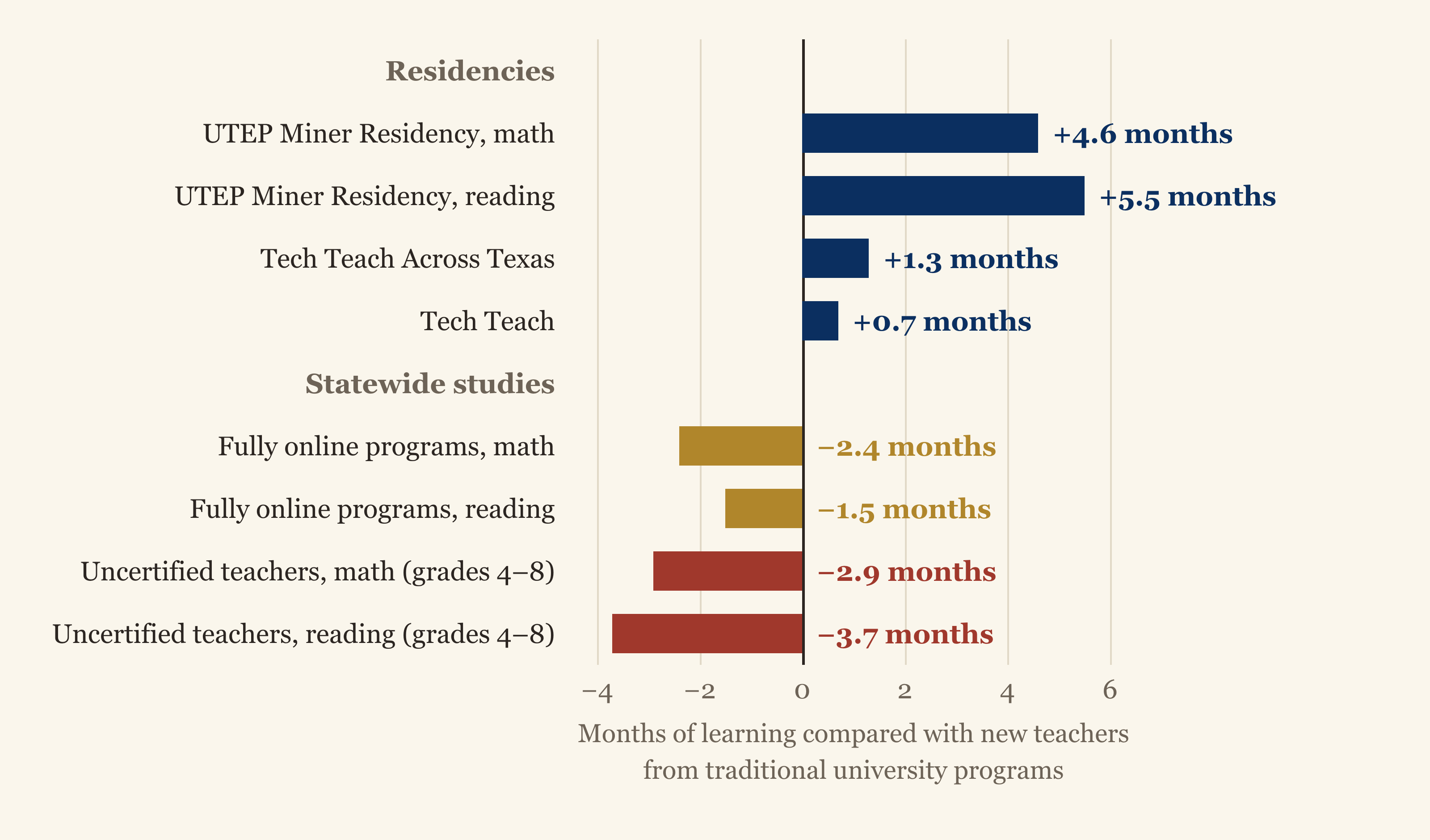
Residency results compare teachers at the same campuses, and Texas Tech’s results average all STAAR-tested grades and subjects. Statewide results come from studies of fully online programs and of uncertified teachers (grades 4 through 8).
Being more effective is exactly what TIA pays for, and residency graduates are much more likely to get TIA by their third year in the classroom. In TIA districts, TTAT teachers were about four times as likely to hold a designation as new teachers from traditional university programs at the same campuses, and UTEP’s residents were about 50% more likely.
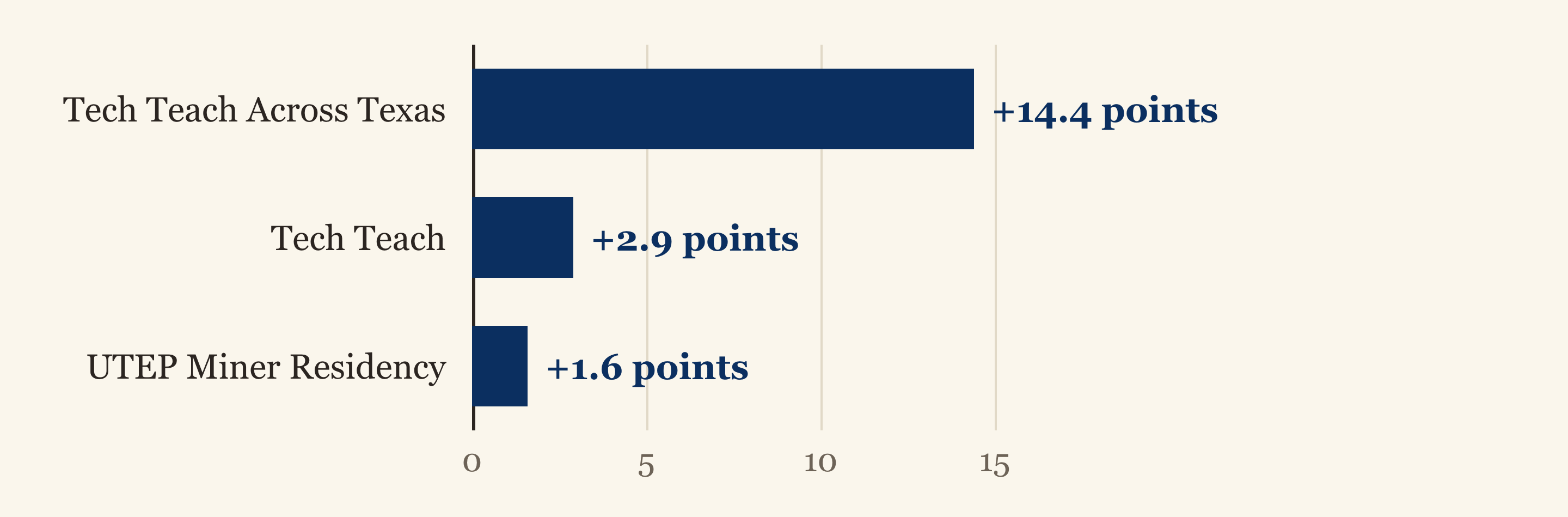
Difference in the likelihood of holding a TIA designation, new teachers in TIA districts, compared with new teachers from traditional university programs at the same campuses.
Again, the starting salary is not bad. Ten years after graduation, though, the typical Texas graduate made about $79,100 in 2024. Texas teachers with 6 to 10 years of experience averaged about $62,600.
TIA is closing that longstanding difference in pay. An average TIA designation paid about $11,800 a year in 2024-25, which covers more than two-thirds of that gap, and a Master designation paid about $20,900, which covers the gap entirely.
A teacher 6 to 10 years in with a Master payout made about $83,500, more than the typical Texas graduate ten years out and more than the average teacher with over 30 years in the classroom.
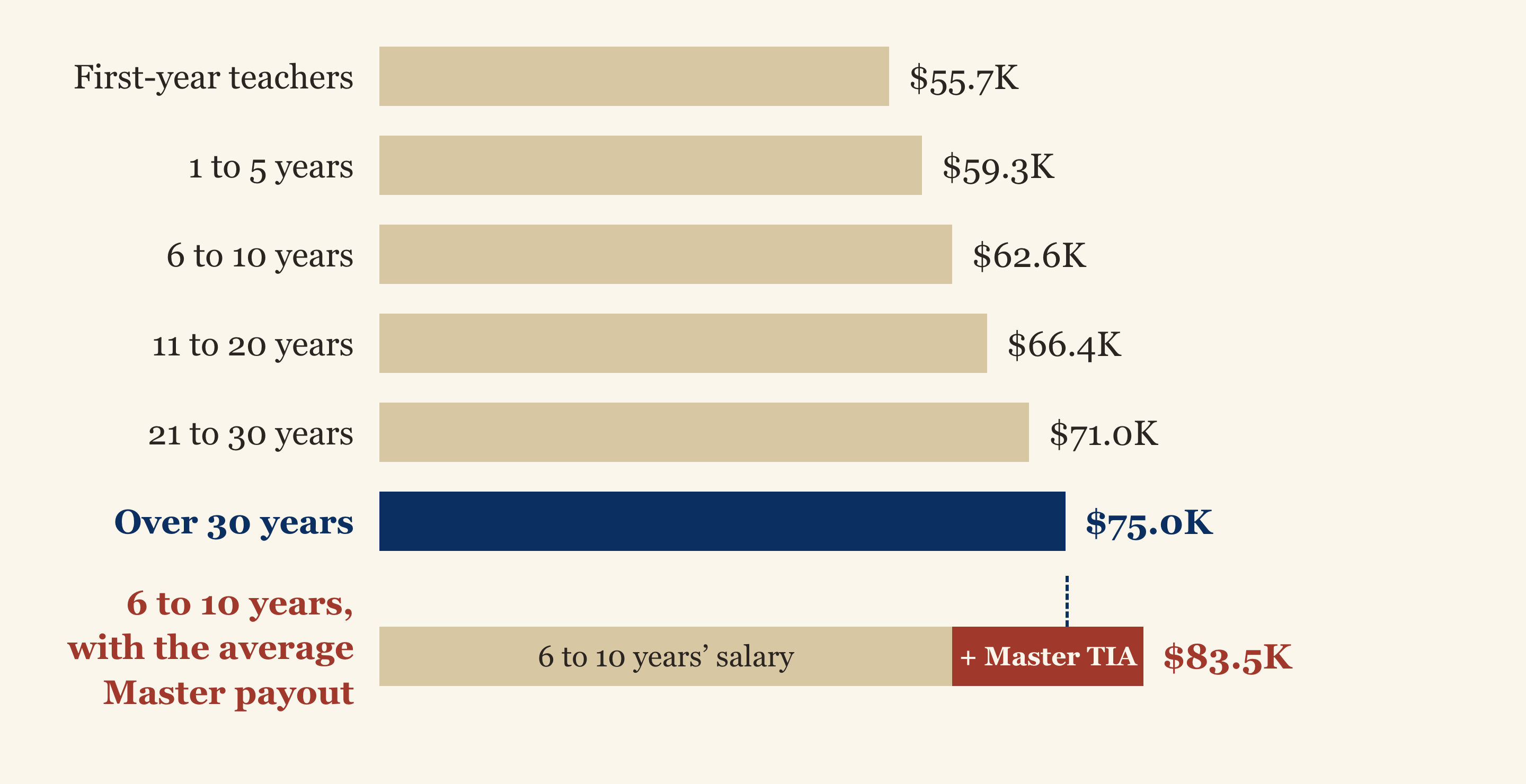
Average Texas teacher salary by years of experience, 2024-25. The last bar adds the average Master TIA payout to the average salary for 6 to 10 years. Source: Texas Education Agency.
In my research on TIA, districts that adopted it saw their most effective teachers become about 20% less likely to leave. Compared to new, traditional university-prepared teachers at the same campuses, UTEP’s residents were about 16% more likely to still be teaching in Texas three years later, and TTAT teachers were about 11% more likely to remain in Texas classrooms each year.
So good preparation leads to TIA, and TIA keeps teachers. That’s the selling point for convincing someone why they should choose a high-quality teacher preparation program.
The story colleges of education can tell
In 2025-26, fewer teachers were entering classrooms without certification, but the share entering through fast-track, online programs went up. That’s what keeps me up at night. I worry we are seeing people opt for the fast track when the state has made a significant investment in high-quality teacher preparation programs.
House Bill 2 phases out uncertified teachers in core subjects by 2029-30, and those people won’t stop wanting to teach. In 2025-26, about 12,100 first-time hires were uncertified. This fall, about 1,500 people are in a paid residency through the PREP allotment.
Are we going to revert back to the mid-2010s, when online programs passed university programs, or are we going to tell a convincing story that motivates future teachers to pursue the best preparation available to them?
This is part of how colleges of education can begin marketing their programs. We should not expect candidates to find and choose us when there are cheaper alternatives that get them to the same starting salary more quickly.
The choice to become a well-prepared teacher should not be made without the consideration of immediate and future costs. From decades of research, we know one of the biggest reasons people go into teaching is that they want to make a difference. Caring is great, but while caring may get teachers into the classroom, it is not enough to make them stay. What keeps teachers is that they feel they are prepared, they are making a difference for kids, and they are being paid for it. That is the return on investment that has long been absent from the teaching profession.
We can start telling the story now.
Notes
I work at Texas Tech but don’t hold an appointment in its preparation programs. I also consult with districts on their TIA designation systems, and my university does the state’s TIA data validation. I convert test-score differences to months of learning by counting a quarter of a standard deviation as about nine months. The conclusions of this research do not necessarily reflect the opinions or official position of the Texas Education Agency, the Texas Higher Education Coordinating Board, the Texas Workforce Commission, or the State of Texas.