

Austin ISD headquarters. Photo by Larry D. Moore, CC BY 4.0, via Wikimedia Commons
After my post on how the Houston ISD takeover changed which teachers left and which kids had access to effective teachers, a reader wrote in with a theory about Austin ISD. Their hunch was that since COVID, Austin ISD has had a hard time putting certified and experienced teachers in its most struggling schools, and that the district stopped being a place teachers wanted to work.
According to the latest data, the reader is half right. Austin’s teachers aren’t leaving at unusual rates, but new hires started to look very different compared to previous years, especially teachers who ended up in the schools that were already struggling.
Burnet and Webb middle schools received a preliminary fifth straight failing rating in August, while the district as a whole earned a B. Under state law, five straight failing ratings mean the commissioner has to close the campus or replace Austin’s elected school board. Although, this has gotten a bit complicated with the latest efforts to petition to close the two middle schools. TEA will finalize the ratings by Dec. 11, and we will know the fate of the district as early as January.
The drama over Burnet and Webb has been about who should be in charge, the state or Austin’s elected board. But whoever runs those schools in January should pay attention to the teachers currently in the building and how the district has historically staffed the campuses. While questions about who will run the district linger, I’d argue the better question is who is teaching these middle schoolers, and who should be.
Who Austin hired for its struggling schools
Using statewide data, I ranked Texas teachers of tested grades and subjects using a value-added measure, which compares how much their students grew on state tests with the growth of similar students elsewhere in Texas.1 Since 2022-23, almost two in three of the new teachers hired at Austin’s lowest-performing campuses ranked in the bottom quarter of Texas teachers. At its highest-performing campuses, it was about one in three.
Austin’s struggling campuses were getting weaker hires before COVID too, when about half of their new hires ranked in the bottom quarter. Now it’s almost two in three, and a lot of those new hires weren’t certified to teach.
In 2021-22, fewer than 1% of Austin’s teachers were uncertified. In 2024-25, it was 11%, above the roughly 8% in traditional Texas districts and the 7% in the suburban districts that hire from the same Central Texas job market.2 The change came from who the district hired as brand-new teachers. In 2023-24, more than half of the first-year teachers Austin hired were uncertified.
That same year, Austin’s share of uncertified teachers matched Houston’s. Houston was in its first year under state control, and about a quarter of its teachers were new to the district. Austin hired uncertified teachers at the same rate, despite having lower turnover and none of the upheaval of a state takeover.
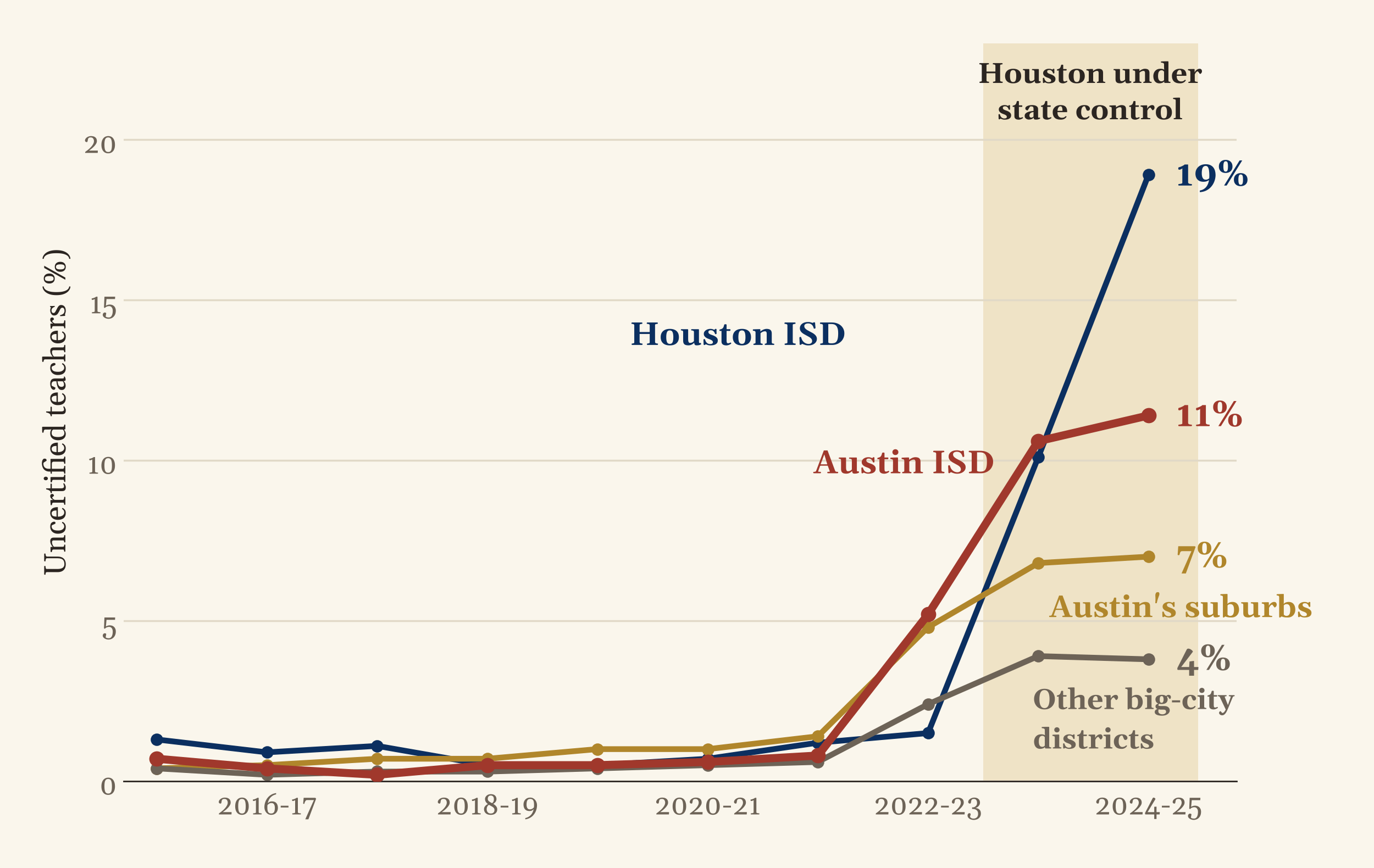
Share of uncertified teachers, 2015-16 to 2024-25. Shading marks Houston’s years under state control.
Those teachers weren’t hired evenly across the district’s campuses. At Austin’s lowest- and middle-performing campuses, about one in six teachers were uncertified in 2024-25. At its highest-performing campuses, it was less than half that.
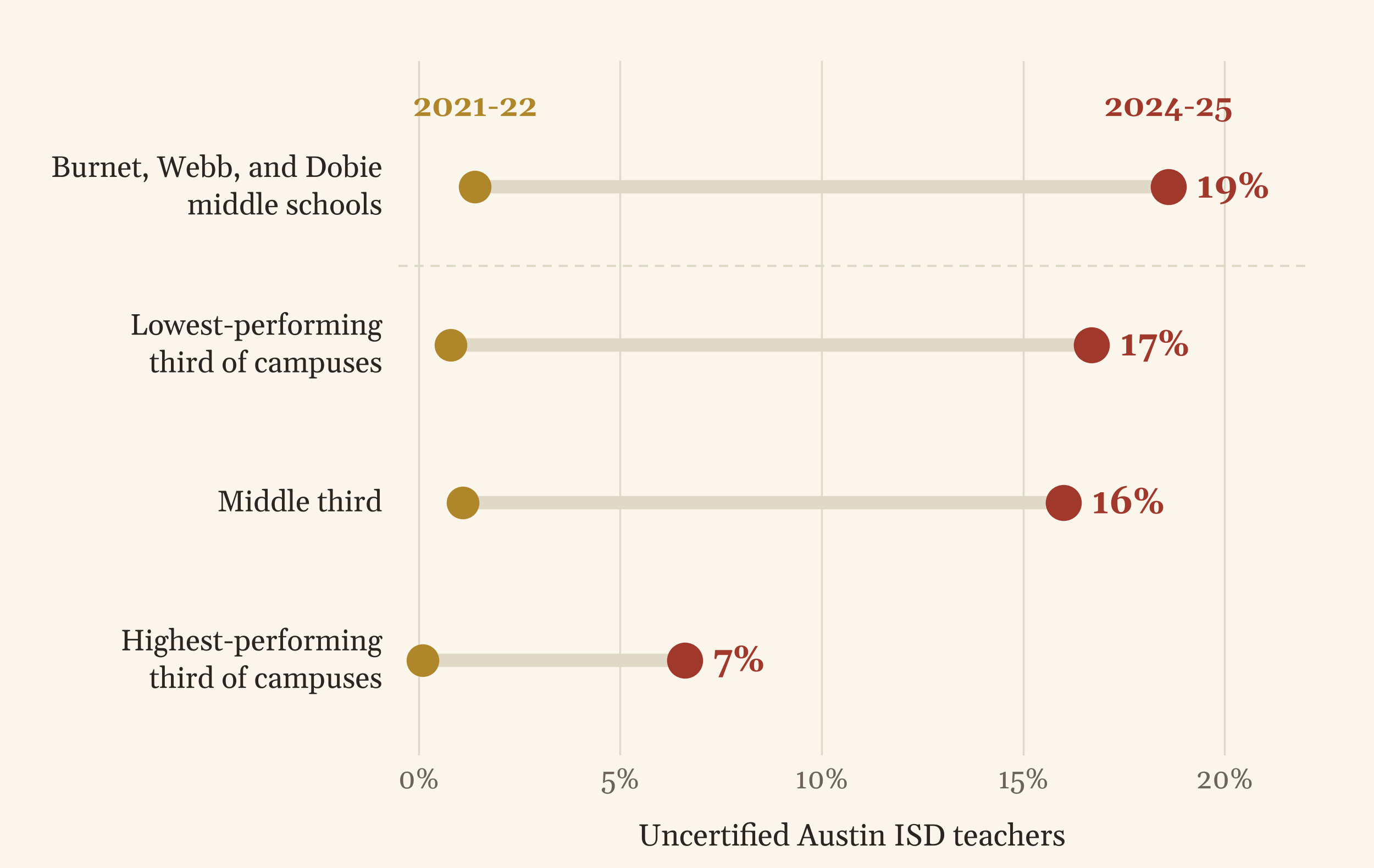
Share of uncertified Austin ISD teachers, by campus performance before COVID, 2021-22 and 2024-25.
Those top campuses are also the district’s wealthiest. About one in four of their students comes from a low-income family, compared with about nine in ten at the lowest-performing campuses. So the students with the fewest resources at home were the most likely to have an uncertified teacher, which my own research shows costs students months of learning.
What that looks like at Burnet, Webb, and Dobie
Burnet, Webb, and Dobie, the three middle schools that went into this year with four straight failing ratings, are where you can see these unfortunate patterns most clearly. Since 2022-23, about three in four of their new hires ranked in the bottom quarter of Texas teachers. No teacher ranked in the top quarter. In 2023-24, one in five of their teachers were uncertified, about double the rest of the district. And after 2024-25, more than half of their teachers left their campus.
Before COVID, about one in eleven students at Burnet, Webb, and Dobie had a teacher from the top quarter of Texas teachers, about the same as at Austin’s highest-performing campuses. By 2024-25, it was fewer than one in forty. At the top campuses, it actually went up.
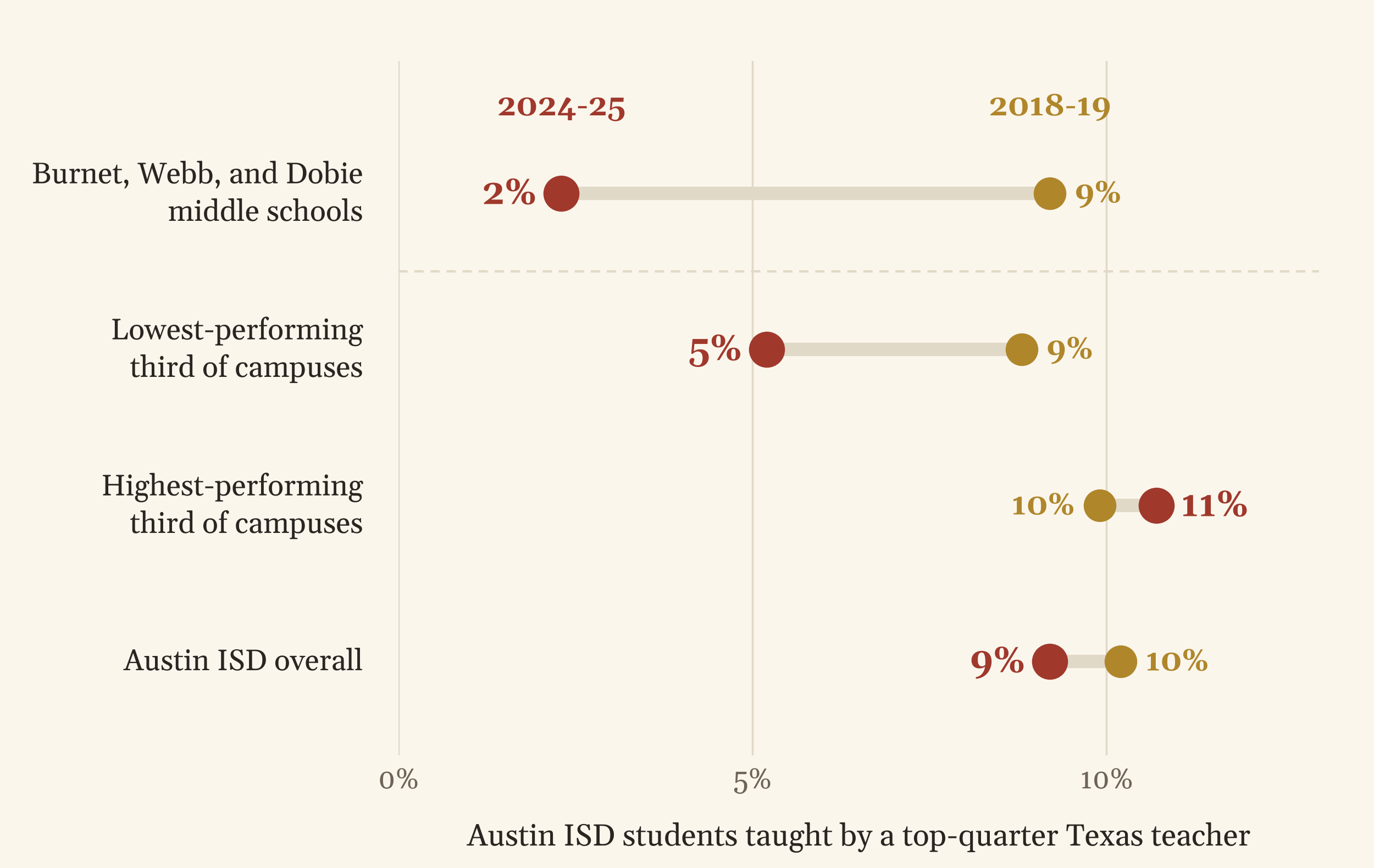
Share of Austin ISD students taught by a teacher in the top quarter of Texas teachers by value-added, 2018-19 and 2024-25. The lowest-performing third excludes Burnet, Webb, and Dobie.
A failing rating reflects more than who is teaching, and my value-added measure only covers teachers of tested grades and subjects, about a third of Austin’s teachers. But I can’t think of a fair reading of these numbers where the kids at Burnet, Webb, and Dobie got the teachers they needed.
Austin has the teachers
The reader was absolutely correct that under-performing campuses are staffed with more uncertified and less effective teachers. But it’s not because Austin is losing its teachers. Its turnover has been around 15% since 2022-23, a little lower than in the surrounding suburban districts. And it isn’t losing its best teachers either. After 2024-25, about one in five of Austin’s least effective teachers left the district, compared with about one in ten of its most effective.
Was Austin ever a destination district? Not in any recent data. But its effective teachers are staying, just not at the schools that need them most. That’s the part that frustrates me.
Houston showed that can change. Its New Education System made every employee at its struggling campuses reapply for their job, paid rehired teachers substantially more, and moved grading and other non-instructional work to aides. The share of students on those campuses taught by one of the district’s most effective teachers roughly doubled.
Austin doesn’t have to copy Houston to do something about this. But it is worth asking: How many of the district’s most effective teachers will be teaching at Burnet and Webb next fall? How can we support their uncertified and novice teachers?
Two more Austin schools, Linder and Pecan Springs, are one bad year from where Burnet and Webb are now. Petitions and closing buildings won’t solve the reality that Austin ISD has two tiers of schools, and the gap between them has been growing. The district can close schools, or the state can take them over, but either way those kids still need a good teacher in August.
Value-added compares each teacher's students' test score growth with that of similar students statewide, accounting for prior scores and student and classroom characteristics. Teachers are grouped into quarters statewide each year. New hires are ranked on their value-added in the year they were hired. Exits by effectiveness compare quarters of Austin teachers.
These numbers come from Education Research Center data of teachers of record, 2013-14 through 2024-25, excluding charter schools. Austin's suburbs are 17 Central Texas districts, including Round Rock, Leander, Pflugerville, Hays, and Georgetown. The conclusions of this research do not necessarily reflect the opinions or official position of the Texas Education Agency, the Texas Higher Education Coordinating Board, the Texas Workforce Commission, or the State of Texas.
Have you considered measuring teacher performance on input metrics rather than output metrics?
Sometimes the scoreboard (student test scores) at the end of a game doesn’t tell the whole story.